Skip to content

CloudSlash — Autonomous Cloud Cost Optimization & Governance

⚡ Shift-Left CI/CD Scanning

Run cs scan in GitHub Actions, GitLab CI, or Azure DevOps. Analyze Terraform plans before they merge. Gate on policy violations with SARIF output.

🧠 AI Copilot (DEVI)

Ask natural-language questions about your infrastructure. DEVI uses a two-tier hybrid architecture — fast deterministic routing for simple queries, frontier models for blast-radius analysis.

🔒 Reversible Remediation

Every action flows through s.a.u saga verification before touching anything. CRDT-backed state guarantees convergence. Compensating rollbacks are mandatory. Nothing changes unless it is safe to undo.

📊 Three Interfaces, One Engine

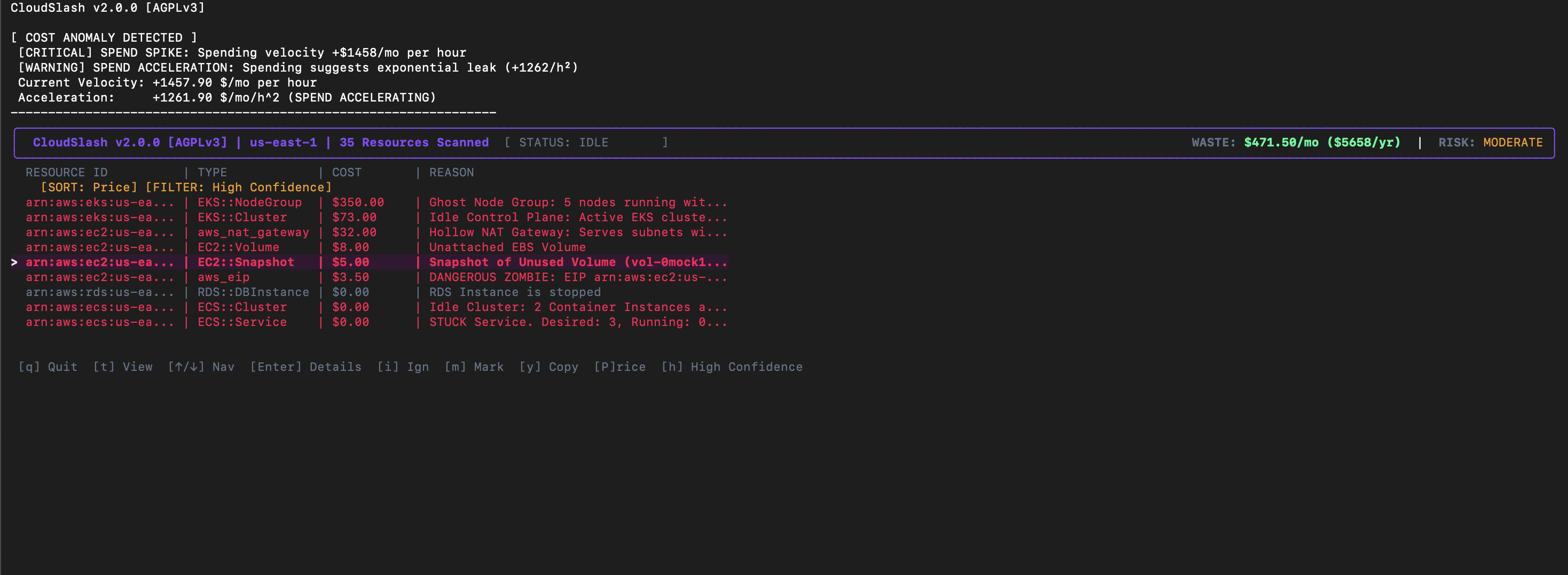
CLI for CI/CD, a Bloomberg-style TUI for real-time monitoring, and a Web Dashboard for visual topology — all backed by the same BadgerDB graph and gRPC plugin system.


Quick Start

curl -fsSL https://cloudslash.dev/install.sh | bash
brew tap DrSkyle/tap
brew install cloudslash
go install github.com/DrSkyle/cloudslash/v2/cmd/cloudslash-cli@latest
git clone https://github.com/DrSkyle/CloudSlash.git
cd CloudSlash && go build -o cloudslash ./cmd/cloudslash-cli

Initialize and run your first scan:

cs init            # Detect credentials, provision graph store, configure AI
cs scan            # Run the full analysis pipeline (table output)
cs tui             # Open the Bloomberg-style terminal dashboard
cs daemon          # Start the daemon + Web UI at localhost:8080
Tip

No cloud credentials? Run cs daemon --mock to explore with a simulated 10,000-node infrastructure graph. No API keys required. The scanner automatically degrades to static analysis mode when credentials are absent.


How It Works

graph LR
    CLI["cs scan / cs tui"] -->|Unix Socket| D["Daemon"]
    Web["Web UI :8080"] -->|HTTP + WebSocket| D
    D -->|Callbacks| E["Engine"]
    E -->|gRPC| P1["Plugin: AWS"]
    E -->|gRPC| P2["Plugin: GCP"]
    E -->|gRPC| P3["Plugin: Azure"]
    E -->|gRPC| P4["Plugin: K8s"]
    E -->|gRPC| P5["Plugin: Linode"]
    E --> H["Heuristics"]
    E --> O["Oracle"]
    E --> PM["PolicyMesh"]
    E --> M["s.a.u Sagas"]
    D -->|Inject Handler| AI["DEVI AI Agent"]
    AI --> LLM["OpenAI / Anthropic / Gemini / Ollama"]

CloudSlash is built on six core engines:

Devi

Universal Graph Discovery

The central topology engine. Every cloud resource becomes a node in a normalized, in-memory graph. Plugins stream resources over gRPC. The Ghost Linker resolves cross-provider dependencies automatically — an AWS Transit Gateway connected to a GCP Cloud Router, a Kubernetes pod backed by an RDS instance, a Linode volume attached to a compute instance.

The graph persists to a local BadgerDB store with temporal snapshots. This enables time-travel queries across your infrastructure history. Devi also acts as your AI Copilot, using MCP tools to traverse this graph and reason about your infrastructure.

Swarm

Rate-Limit-Safe Concurrency

Scanning large cloud accounts means hitting API rate limits. Swarm solves this with an AIMD (Additive-Increase/Multiplicative-Decrease) congestion control algorithm. This mirrors TCP window scaling: the worker pool grows on successful API calls and shrinks on rate-limit responses, maximizing throughput without hardcoded delays.

s.a.u

Reversible Remediation

Every remediation action flows through the s.a.u (Sequential Atomic Unwind) saga engine before touching your infrastructure. s.a.u models the blast radius as a directed graph. It requires compensating (rollback) actions for each step. It verifies network flow remains intact using Dinic's Maximum Flow algorithm. If anything looks unsafe, the action is blocked automatically.

State changes are tracked with CRDTs. This guarantees convergence even under concurrent modifications.

PolicyMesh

CEL Governance

Write governance rules using the Common Expression Language. PolicyMesh evaluates rules against every graph node using an inverted index for O(1) candidate lookup. It intercepts DAG operations and blocks s.a.u remediations that violate active policies.

Oracle

Formal Verification & Cost Modeling

Translating raw cluster metrics into deterministic financial savings. Oracle uses a native Branch and Bound algorithm to solve Mixed-Integer Linear Programming (MILP) equations. This guarantees lowest-bound cluster provisioning costs. It also uses Hidden Markov Models (HMM) to predict spot instance termination probability.

Rosetta

GitOps Provenance & Drift Surgery

Given a live cloud resource, Rosetta traces it back to the exact Terraform source file, commit hash, author email, and line number that created it. The Drift Surgeon evaluates infrastructure drift and applies precision patches without destroying resources; every patch is reversible.


Three Interfaces, One Engine

Interface Launch Command Best For
CLI cs scan, cs diff, cs report CI/CD pipelines, scripting, quick checks
Terminal Dashboard cs tui Real-time monitoring, interactive remediation, AI chat
Web Dashboard cs daemonlocalhost:8080 Visual topology, drag-and-drop pipeline, team collaboration

All three interfaces connect to the same daemon. They share the same graph, policies, and remediation state.


Key Capabilities

Install CloudSlash and run your first scan in under 2 minutes.

Step-by-step walkthroughs for cost optimization, governance, and compliance.

Task-oriented guides for CI/CD, CEL policies, plugins, and deployment.

Complete CLI, API, configuration, and plugin specifications.

Deep technical details on the engine pipeline, graph algorithms, and saga patterns.

Common issues and verified solutions.